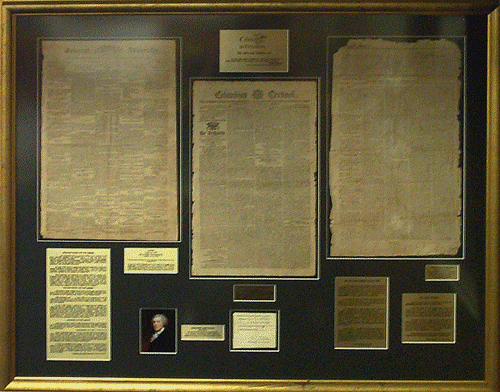
CRISIS IN FREEDOM
The Alien and Sedition Acts
“I know not which mortifies me most, that I should fear to write what I think or my country bear such a state of things.”
-Thomas Jefferson
BENJAMIN BACHE AND THE AURORA
“…the Federalists did not need the Sedition Act to ensure a loyal press; generally speaking, they already had it. To this rule there were, however, some notable exceptions… Chief among them was the Aurora, edited by Benjamin Bache of Philadelphia. Sometimes called “Lightning Rod, Junior,” Bache was the grandson of Benjamin Franklin; * Bache was fiery, impetuous, and surcharged with passion.
By April, 1798, Bache’s Aurora had gained the distinction of being the leading Republican newspaper in the United States. From the debates in Congress, it appeared that Benjamin Bache’s Aurora was the most telling Federalist argument for the passage of a sedition law.
When following his indictment for seditious libel at common law, Benjamin Bache appeared before Judge Richard Peters of the United States Supreme Court, be brought with him, as counsels, Moses Levy and Alexander James Dallas, two radical Philadelphia lawyers. Before Bache could be brought to trial or disposed of otherwise, he died of yellow fever in the great epidemic of 1798. * The only result of the government’s prosecution of Bache was to increase the influence and the circulation of the Aurora. “
WILLIAM DUANE AND THE AURORA
After Bache’s death, William Duane took over the paper and with it Mrs. Bache, whom he married in 1800. If anyone could make the Federalists regret the untimely end of “Lightning Rod, Junior”, it was William Duane.
[The]Federalist mob… In May 1799, he was attacked by a mob of civilians and army officers and was knocked down and soundly kicked,… But when Duane and his companions were tried for seditious riot in the state courts, they were acquitted.
In July, 1799, Duane * declared in the Aurora that the British were calling the tune for administration policies… less than a week after the publication of his article, Duane was arrested by a Federal marshal. But when Duane came up for trial * the case against him collapsed. Duane owed his reprieve to the fact that * the Republican editor was making no idle boast when he claimed to have documentary evidence in John Adam’s handwriting of British influence. Several years before, John Adams had written a letter to Tench Coxe, then Hamilton’s assistant in the Treasury.
CONTEMPT OF THE SENATE
Duane learned that a bill for settling disputed elections of the President and Vice President had been introduced into the Senate. This bill provided for the establishment of a tribunal * meeting behind closed doors * The Aurora loudly cried fraud.
–Crisis in Freedom by John C. Miller [26,28,60,64,93,94,96,194-99]
Duane, appearing before the Senate, requested that he be permitted to advise with counsel and withdrew. According to his plan, he then addressed letters to Dallas and Cooper, asking them to serve as counsel. This they both declined to do on the ground that the Senate had already prejudged the case and that they would only degrade themselves by appearing before the Senate under the limitations and restrictions that body had imposed *
* All this he published in the Aurora. The Senate then declared Duane guilty of contempt * and issued a warrant for his arrest… Duane evaded the process server until after the adjournment of Congress * Because of a succession of delays * nothing ever came of the prosecution of Duane, against whom proceedings were finally dropped after the former Vice President had become President.
-III Jefferson and the Ordeal of Democracy by Dumas Malone [465-6]
The Alien and Sedition Acts of 1798
“For the first ten years of its existence under the Federal Constitution of 1787, the government of the United States was in the hands of the Federalists party. * To save the United States from the evils of unlimited democracy was to most Federalists one of the historic missions of their party. * Opposition to the administration * became opposition to the Constitution;
In enacting the Alien and Sedition laws, the Federalists professed to act upon this premise: that a dangerous French faction was at work in the United States and that the survival of the Republic required that it be stamped out….
The Federalists, far from holding public opinion in contempt, regarded it as the mainspring of government:… If public opinion formed the basis of government, the press in turn formed public opinion…. And so the Federalists were driven to the conclusion that every government that depended upon the support of public opinion must take measure to ensure that it enjoyed a favorable press. This could be done only by suppressing criticism and slander directed against the government and its officers.
Seditious libel, * was defined as an attempt to defame or weaken the government and laws of the United States * or attempts to defame the President and other Federal officials. Many of the states had enacted statutes affirming the common-law doctrine of seditious and malicious libels – and this in spite of the strict injunction written into their constitutions providing for the freedom of the press.
– Crisis In Freedom by John C. Miller
Boston, 1951 [3,15,11,24,56,59]
The Trial of Adams
Even in Boston * there was a Republican newspaper, the Independent Chronicle, edited by Thomas Adams.
Action was begun in 1798 against Adams under the Sedition Act; and, * he was indicted by the State of Massachusetts for libeling the members of the Massachusetts General Court. Adams succeeded in cheating the hangman: before he could be brought to trial he died of a lingering illness.
The death of Thomas Adams did not wholly balk the course of justice: his brother, Abijah, had also been indicted in the prosecution begun by the State of Massachusetts and upon him the full force of the law was turned. True, Abijah Adams had served only as bookkeeper; but as he sometimes sorted out the papers, he was legally held to be a principal.
The jury promptly returned a verdict of publishing a libel –
* Abijah Adams was fined and sentenced to a month in jail.
– Crisis in Freedom by John C. Miller [120-122]
Take a closer look


 HistoricTrials.com