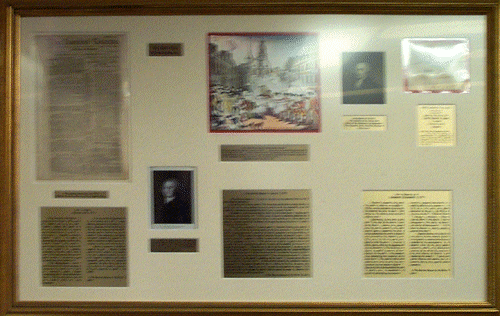
 The Boston Massacre: March 5, 1770
“The Boston Massacre * is a part, not only of our national history, but of our national mythology.
Here the star is John Adams. We know that purely from a sense of duty, at great risk to his own popularity lawyer Adams took the impossible case and somehow convinced an implacably hostile jury to acquit his client.
In Boston, a secret group calling itself the Loyal Nine began * to plan active opposition to the Stamp Act. * [T]he value of Boston’s mobbish tradition lay in the immediate availability of a corps of husky, willing bully-boys. Their object was simple: Compel repeal of the Stamp Act by putting those who were to * enforce it in fear of their lives.
The evening of March 5 * began quietly. Thomas Preston was captain of the day. Private White had been posted in the little sentry box. * Garrick *one of the * young apprentices * arrived. If Garrick’s purpose was to taunt White, he succeeded. White swung his musket striking the side of Garrick’s head. The ruckus attracted * attention. When a church bell rang the alarm, Bostonians hurried en masse to the site. * The crowd was so large, so angry and so well armed that no one could fairly expect the sight of the handful of red coats * to frighten it into order. ‘Take out six or seven of the men and * go down to the assistance of the sentry’, Preston said. The relief party fell out, corporal William Wemms and six privates * When Preston arrived * he ordered the sentry to fall in. Then Preston tried to march the party back * The crowd pressed around. Preston stood * in front of the soldiers, shouting at the crowd. * Up and down the line, men dared the red coats to fire. A club arched through the moonlight catching Montgomery * his musket dropped to the ice. Rising to his feet, in agony, rage, frustration and fear, ‘Damn you, fire!’ he roared, and pulled the trigger. * The pause after the first shot quickly ended * Kilroy raised his weapon. Another shot. The mob advanced, more guns fired. ”
– The Boston Massacre by Hiller B. Zobel
Rex v. Preston
October 24-30, 1770
“The day after the killings * a message from Preston, ‘Who wishes for Council and can get none’. ‘Council’, Adams said ‘ought to be the very last thing that an accused person should want (i.e. lack) in a free country’. A problem concerned Adams * since * he would be appearing and arguing in both trials.
Captain Preston’s best defense would consist simply of a denial that he had ordered the shooting. Conversely, the men would want to show * they had merely followed their officer’s orders, * as indeed on pain of death they were bound to do.
The Massachusetts courts which allowed for twenty peremptory challenges in a murder case * of the first twenty-two called, Preston challenged fifteen, seven of them from Boston. Of the seven jurors who had been seated, only two were Bostonians.
It is an axiom of litigation that a case should open with a strong witness, and also close with one. In Rex v. Preston, the crown lawyers put all their good witnesses in the middle. Though neither Preston nor his men testified, * the witnesses who did take the stand * sealed his acquittal. The defense evidence create/de a picture of confusion, noise, and verbal threats.
Adams’s argument * brilliantly capped the case. Without calling anyone a liar, without over painting the scene, Adams brought the jurors into Preston’s situation and subtly reminded them that the unleashed ‘passions’ in Iong Street might well have forced the soldiers response. The jury reported its verdict: Not Guilty. “
– The Boston Massacre by Hiller B. Zobel
Rex v. Wemms, et al.
November 27-December 5, 1770
“Preston’s acquittal only made the soldiers’ defense more difficult. *[T]he crown had failed to prove that he ordered his men to shoot. That being so, the soldiers must have fired without orders.
[S]electing a jury took a long time * Not one of the twelve * came from Boston. Adams now stepped into the senior counsel’s role, while Josiah Quincy assumed the task of cross-examining the crown’s witnesses and presenting the defense’s case. ‘The eyes of all are upon you’, Quincy told the jurors. ‘You are to think, judge, and act as Jurymen and not as Statesmen’. The testimony now began to unfold a picture of direct threats to the party. The testimony was cumulating into a picture of riot and threat. The speech which John Adams now rose to give has never received its true measure of fame * But never has it been praised for what it really was, a masterpiece of political tightroping and partisan invective, wrapped inextricably in a skillful, effective jury argument. * at 1:30 p.m. the case was finally delivered to the jury. By 4:00 p.m. the jury was back. * William Wemms * Hartigan, McCanley, Warren, Caroll, White * Not Guilty. * Kilroy, Montgomery ‘Not Guilty of Murder, but Guilty of Manslaughter’. * [T]he Boston Massacre, legally speaking, passed into history.
Popular feeling very clearly did not rejoice in that triumph of justice over prejudice. Adams himself always considered his participation in the defense ‘one of the most gallant, generous, manly and disinterested Actions of my whole life, and one of the best Pieces of Service I ever rendered my Country. ‘ * years later when Preston and Adams met on a London Street, they passed without speaking. “
– The Boston Massacre by Hiller B. Zobel
Take a closer look

Reports the Boston Massacre Trial of Captain Preston

 HistoricTrials.com