
“A NOBLE FOUNDATION FOR SECURING LIBERTY”
-Andrew Hamilton’s Argument to the Jury
“The Trial of Zenger in 1735 was the germ of American freedom, the morning star of that liberty which subsequently revolutionized America.”
-Gouverneur Morris 1752-1816 [Quoted in John Peter Zenger by Livingston Rutherford (NY 1941)]
THE DEBT FREE MEN OWE TO FREE SPEECH
-Stanley Katz: 1972 Introduction to A Brief Narrative of the Cafe and Tryal of John Peter Zenger by James Alexander (1736
The arrival in August 1732 of William Cosby us governor of New York set in motion the train of political events that concluded in the trial of John Peter Zenger. * Cosby was a “rogue governor” * from the moment he stepped ashore. He was quick-tempered, haughty, unlettered, jealous, and above all greedy.
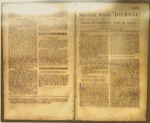
Thus, by 1734, a full-scale opposition faction had been created in New York * Cosby’s opponents were hampered, however, by the fact that New York’s sole newspaper * was “a paper known to be under the direction of the government.”* This situation was transformed on November 5, 1733, however, with the publication of the inaugural issue of the New York Weekly Journal, America’s first party newspaper. * The Weekly Journal was printed and published at the modest print shop of John Peter Zenger. * The guiding genius and effective editor of the Journal was James Alexander.
Zenger printed criticism of the governing regime in at least three forms: satire, reportage, and essays on government. * Governor Cosby decided to still its voice.
On November 17 the Sheriff imprisoned Zenger. He was arrested on the Council’s warrant which charged him with printing and publishing seditious libels * The opposition party came to the printer’s defense. On November 18 James Alexander and William Smith were formally engaged as his attorneys …Smith and Alexander * offered exceptions to the commissions of the two Supreme Court judges. * Chief Justice DeLancey refused to hear the exceptions in court, and * he disbarred Smith and Alexander.
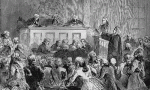
Zenger petitioned the court * to appoint a lawyer for him. The Chief Justice obliged by naming John Chambers, a competent lawyer but a Governor’s man. * In a brilliant stroke, Alexander engaged Andrew Hamilton of Philadelphia to defend Zenger. Zenger’s trial * took place on August 4, 1736. After the Attorney General read his information, Chambers delivered his opening speech, and the stage seemed set for a weak defense of the printer. * Andrew Hamilton rose dramatically from his chair in the City Hall courtroom, and announced * that he would participate in Zenger’s defense. Armed with years of courtroom experience and a well-prepared brief, speaking with the daring of one indifferent to the local political contests, Hamilton made short work of convincing the * jury of Zenger’s innocence. When the arguments were concluded at the end of the day, it took the jury only a few minutes to return a verdict of not guilty. “Huzza” rang out for Zenger and Hamilton.
-Stanley N. Katz: 1972 Introduction to A Brief Narrative of the Case and Trial of John Peter Zenqer by James Alexander (1736)
Take a closer look

Library of Congress
(Original Painting in Private Collection)
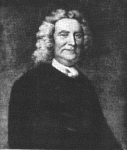

1676-1741
Philadelphia Lawyer


 HistoricTrials.com